passive voice
Constructio evasoria
Description
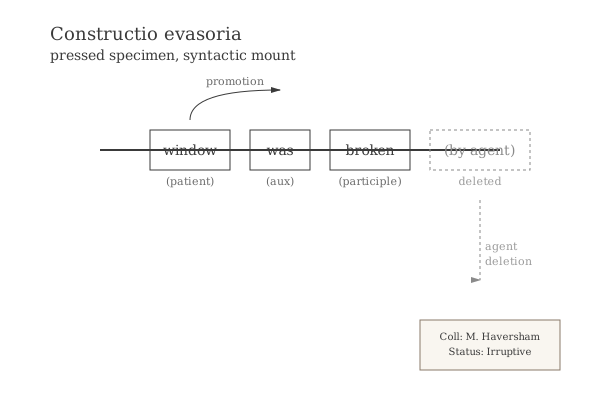
A grammatical construction in which the patient (object of action) is promoted to subject position while the agent (performer of action) is demoted, deleted, or relegated to an optional prepositional phrase. The construction employs a characteristic two-part auxiliary structure: be (carrying tense) + past participle (carrying semantic content). Examples: “The window was broken,” “The solution is being heated,” “Measures will have been implemented.”
The passive voice exhibits remarkable morphological flexibility, adapting to any transitive verb in the language. This generative capacity—the ability to parasitize active constructions and transform them—explains both its persistence and its irruptive potential. Each new verb entering the language immediately becomes potential habitat.
The construction solves a communicative problem: sometimes agency genuinely does not matter, is not known, or must not be mentioned. In scientific writing, “the enzyme was discovered in 1967” properly centers the discovery over the discoverer. In recipes, “the mixture should be stirred” focuses on process over performer. Not all evasion is cowardice; sometimes it is courtesy.
Status
Irruptive. The passive voice explodes unpredictably in usage across different discourse domains. It maintains robust deployment in scientific and bureaucratic writing, where it serves essential communicative functions. Population cycles are driven by social and professional pressures: the construction irrupts in contexts where responsibility requires distribution rather than location, then recedes when direct attribution becomes necessary or fashionable. Centuries of persecution by style guides and composition instructors have not diminished its adaptive capacity.
Range
Breeds reliably in scientific reports (“the solution was heated”), incident documentation (“windows were found broken”), policy documents (“measures will be implemented”), and corporate communications (“mistakes were made”). Maintains stable populations in academic hedging, diplomatic language, and bureaucratic euphemism. Migrates seasonally between domains of power and domains of protocol. Range is essentially universal across English-language writing, with particularly dense populations in institutional and professional contexts where agency obscuration serves communicative or political function.
Call
The passive voice vocalizes in a characteristic two-part structure: auxiliary be + past participle. The auxiliary carries tense and mood while the participle carries semantic content—a divided labor that allows the construction to slip temporal anchors as needed. Stress falls on the participle. Typical position: sentence-initial or medial, with the promoted patient occupying subject slot. Under duress (when direct attribution becomes necessary), the construction may be forced to restore the agent in a by-phrase, but this addition is optional and frequently omitted entirely.
Sign
Look for subject demotion or deletion. In active voice, agents leave clear tracks: “John broke the window.” In passive voice, the subject’s prints appear in the object position (“The window was broken”), while the agent’s tracks vanish entirely or retreat to an optional by-phrase burrow (“…by John”), easily shed when threatened. The characteristic sign is the presence of a past participle in subject-predicate position, often accompanied by auxiliary be. Absence of an explicit agent is diagnostic, though not definitive—the agent may be recoverable from context or may be genuinely unknown.
Easily Confused With
The true confusion lies not in grammatical cousins but in rhetorical mimics—constructions that achieve similar agency-obscuration through entirely different mechanisms.
Middle voice and ergative constructions (“the door opened,” “the ice melted”) superficially resemble passive voice but lack the auxiliary structure and represent genuine intransitivity rather than agent demotion.
Existential there with nominalized verbs (“There has been a decision to restructure”) achieves identical agency-erasure but through existential framing and nominalization rather than passive morphology. The untrained observer sees agency vanishing and assumes passive voice, missing the actual mechanism at work.
Document-as-actor constructions (“The report indicates poor performance”) employ active voice while hiding behind a reified subject, achieving obfuscation through semantic rather than grammatical means.
All three belong to a broader guild of responsibility-distributors—mechanisms that distribute responsibility across linguistic terrain. The passive voice’s distinguishing feature is its morphological signature: the auxiliary be + past participle structure, combined with subject demotion and optional agent deletion.